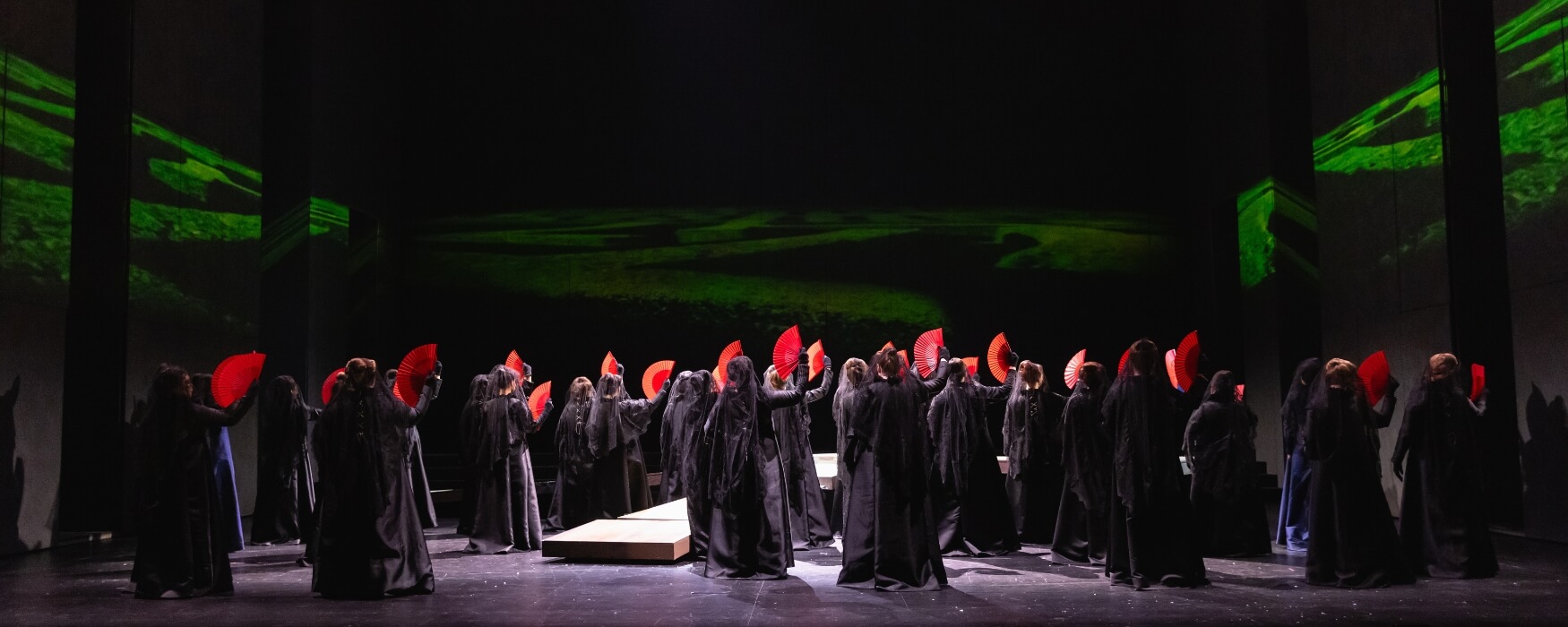
NEW PRODUCTION
Passions and politics ignite in Verdi’s potent drama!
Be there for this stunning season finale! Set amidst the tumult of the Spanish Inquisition, Verdi’s masterpiece has it all—forbidden love, heartfelt bromance, searing family drama, and political intrigue to spare. King Philip II and the fearsome Grand Inquisitor battle for power … and Don Carlo, the king’s heir, struggles to conceal his passion for the Queen, who’s also his stepmother! Foes and friends maneuver and manipulate in one of opera’s most magnificent masterworks.
Verdi’s epic demands the utmost in vocal and dramatic virtuosity. This stupendous cast presents Don Carlo in all its brilliance: Dupuis! Margaine! Van Horn! Robinson! And as the doomed lovers, Nicole Car, hailed as “deeply artistic and full of feeling” (NEW YORK CLASSICAL REVIEW), and “the prodigiously-gifted Stephen Costello.” (ASSOCIATED PRESS)
View the full program here or in the Flip Book below.
Show Details
Language
Sung in Italian with projected English titles
Running Time
Approximately 3 hours and 25 minutes, including one intermission.
Tickets
| Saturday, March 7, 2026 7:30pm | GET TICKETS |
Cast

Stephen Costello
Don Carlo
Nicole Car
Elizabeth de Valois
Etienne Dupuis
Rodrigo
Clémentine Margaine
Princess Eboli
Christian Van Horn
Philip II
Morris Robinson
The Grand Inquisitor
Meghan Kasanders
Celestial Voice
Raymond Aceto
Friar
Gretchen Krupp
Tebaldo
David Bogaev
Count Lerma/HeraldCreative Team

Emmanuel Villaume
Conductor
Louis Désiré
Director
Diego Méndez-Casariego
Set & Costume Designer
Driscoll Otto
Lighting Designer
Zachary Borovay
Projection Designer
David Zimmerman
Wig & Make-Up Designer
Paolo Bressan
Chorus DirectorDon Carlo Synopsis
Act I
In the monastery of San Juste, monks pray at the tomb of Holy Roman Emperor Charles V. Don Carlo comes to lament his ill-starred love for Elisabeth de Valois, who, for reasons of state, has been married to Carlo’s father, King Philip II. He is joined by his friend Rodrigo, Marquis of Posa, who urges Carlo to forget his private grief and join him in Flanders to aid the Protestant population there, oppressed by Philip’s Catholic regime.
Awaiting the queen, Princess Eboli amuses the ladies of the court by singing the Veil Song, about a Moorish king and a veiled beauty who turns out to be his neglected queen. When Elisabeth joins them, Rodrigo brings the queen a letter from her mother. He also gives her another note, a request from Don Carlo for a private audience, and distracts Eboli (who thinks Carlo is in love with her) while Elisabeth reads it. She agrees to see Carlo and dismisses her ladies.
Carlo asks Elisabeth to help him gain Philip’s consent to leave for Flanders. He cannot refrain from speaking also of their past love. Alarmed by the dangerous change in subject, Elisabeth tells him that, as queen, she must remain aloof, but admits that to live beside him would seem like paradise. Overwhelmed, Carlo sinks to the ground. When he regains consciousness and attempts to embrace her, she breaks away. Carlo flees in despair.
Philip arrives to find his queen unattended, and angrily banishes her lady-in-waiting, the Countess of Aremberg, for neglecting her duty. The queen bids her friend a somber farewell. Rodrigo lingers behind with the king and begs him to adopt a more tolerant policy toward his Flemish subjects. Philip refuses and warns Rodrigo to beware of the Grand Inquisitor. Nevertheless, he is impressed with this young man who seeks nothing for himself; he confides to Rodrigo his jealous suspicions about Don Carlo and the queen.
Act II
Don Carlo comes to the garden in response to an unsigned note which he believes is from Elisabeth. However, the letter is from Eboli, who arrives dressed in a veil. Mistaking her for the queen, Carlo passionately declares his love. Enraptured, the princess uncovers her face; she quickly realizes, however, that his ardent speeches were not for her. Rodrigo enters and tries to undo Don Carlo’s indiscretion. Eboli, furious, threatens to tell the king that Elisabeth and Carlo are lovers. Rodrigo tells the imperiled Don Carlo to entrust him with any sensitive political documents in his possession.
The Spanish populace and royal court assemble to witness an auto-da-fé, in which those condemned by the Inquisition are to be burned to death. Don Carlo approaches his father with a group of Flemish deputies who have come to plead for clemency. Philip is unmoved by their entreaty. Carlo infuriates his father by continuing the discussion, asking that the rule of Flanders be entrusted to him. Seeing that words are of no use, Carlo draws his sword. Philip calls for his guards and nobles to disarm the defiant prince, but no one moves to obey him. Finally, Rodrigo steps forward and asks Carlo for his sword, which he then gives to the king. Philip leads his wife to the auto-da-fé as guards remove Carlo to prison. In the distance, a heavenly voice is heard in prayer for the souls of the condemned.
Act III
Philip has spent the entire night in his study in melancholy reverie. His queen, he realizes, never loved him. Don Carlo, whom he suspects of an illicit love for Elisabeth, has now committed open treason against him. The Count of Lerma announces the arrival of the Grand Inquisitor, whom Philip has summoned to discuss Carlo’s punishment. The blind, aged man is led into the king’s presence. Philips hesitates to invoke the death penalty against his son, but the Grand Inquisitor absolves Philip in advance of all guilt, pointing out that God sacrificed His own son for the redemption of the world. The Grand Inquisitor then denounces Rodrigo as a heretic for his efforts on behalf of Flanders; he demands Rodrigo’s death. Philip defends Rodrigo, the only man in his court he can trust. The Inquisitor accuses the king himself of failing in his duty before the Holy Office. Philip’s will collapses; he abandons Rodrigo’s defense.
Elisabeth bursts in: a box containing her jewels and personal effects has been stolen. Philip points to the box, which is on his table, and asks her to open it. When she refuses, he breaks it open and finds a portrait of Carlo inside. Elisabeth defends her innocence in the face of Philip’s fury, but faints when he accuses her of adultery. When Philip calls for help, Eboli and Rodrigo rush into the room. As Eboli looks after the queen, each is troubled by private thoughts. Philip realizes that he has not been betrayed; Eboli repents of her treachery now that she sees its results; Rodrigo resolves that he must sacrifice himself for Spain. When Elisabeth recovers, Philip and Rodrigo withdraw. Eboli confesses to the queen that it was she who gave the jewel box to Philip, in reprisal for being spurned by Carlo. Elisabeth forgives her. Eboli’s contrition also forces her to admit that she herself has committed adultery with Philip. At that, Elisabeth commands Eboli to choose either exile or the cloister. Alone, Eboli resolves to save Don Carlo’s life before she seeks peace in a convent.
Rodrigo comes to Don Carlo’s prison cell to say farewell. He has obtained Carlo’s freedom by claiming ownership of the incriminating papers Carlo gave him. Carlo protests, but Rodrigo is adamant. He is sacrificing himself so that Carlo may live, reign and save Flanders. Suddenly, a gunshot sounds and Rodrigo falls. Mortally wounded, he tells Carlo that Elisabeth knows everything and will meet Carlo the next day at the monastery of San Juste. As he dies, he enjoins Carlo once more to save Flanders. Philip enters to free Carlo, but Carlo turns on him, bitterly accusing him of complicity in Rodrigo’s death. A courtier rushes in to tell Philip that an angry mob has gathered, demanding Carlo’s freedom. Philip orders the gates thrown open, and the mob fills the room. In the confusion, Eboli, disguised, urges Carlo to flee. The Grand Inquisitor appears and invokes the power of God to quell the disturbance.
Act IV
Waiting in the monastery, Elisabeth kneels and unburdens her heart in prayer. Don Carlo arrives for their last meeting. Rodrigo hovers in their thoughts as they speak of Don Carlo’s mission to Flanders. They formally renounce their love and dedicate themselves to their respective duties in a solemn, platonic farewell. Philip enters with the Grand Inquisitor, ready to deliver his son to the Inquisition. From the tomb of Charles V, the figure of a spectral monk emerges leading Don Carlo away into the darkness of the tomb and death.
Synopsis Courtesy of Lyric Opera of Chicago
Pre- and Post-Opera Discussions
Join us for these engaging and informative pre- and post-opera discussions:
Joy and Ronald Mankoff Pre-Opera Talk: Hosted by Mrs. Eugene McDermott Music Director Emmanuel Villaume, this interactive 30-minute lecture begins one hour before the start of each opera in the Margaret McDermott Performance Hall. Admission is free with your ticket to a Dallas Opera performance.
Sunday Post-Opera Talkback: Immediately following the Sunday matinee performance from the stage, this brief and casual Q&A session with members of the cast gives you an opportunity to ask questions about the performance. Hosted by Ian Derrer, The Kern Wildenthal General Director and CEO at The Dallas Opera.
Sponsors
The VanSickle Family Foundation in memory of Edith and Elmer VanSickle
Season Sponsor
Martha McCarty Wells
Presenting Sponsor
Holly and Tom Mayer
Presenting Sponsor
Katherine and Michael E. Phillips
Presenting Sponsor
Enika and Richard Schulze
Presenting Sponsor
Anonymous
Producing Sponsor
Joan S. Reisch
Supporting Sponsor